Digital PR strategy is how you earn attention online through brand mentions, media coverage, and content that other sites want to link to. It isn’t advertising or a press release blast. It’s a strategy for getting your brand into the places that search engines and AI trust the most.
I work with clients across industries, from Gold IRAs to local businesses to e-commerce, and I keep having the same conversation. My clients don’t realize how much visibility they’re leaving on the table by skipping digital PR.
If you’re tired of getting passed over online by your competitors, here’s what you need to know.
Key takeaways
- Digital PR equals trust: Media mentions, helpful content, and unique data. Every business already has at least one, and the more your name shows up in the right places, the more visibility and leads you get.
- Give AI new info: Product pages and generic definitions won’t cut it. Your proprietary data and expert perspectives will.
- Be consistent: Respond to journalists, say yes to podcasts, share data only your company has. Start now, and get ahead before your competitors catch on.
Digital PR vs traditional PR vs link building
People use these three terms as if they mean the same thing. They don’t.
Traditional PR is about reputation. Print, broadcast, events, crisis response. Success is measured in coverage and sentiment, and most of it never touches your website.
Link building is about your backlink profile. The goal is a link, and the tactics are often transactional. Guest post swaps. Paid placements. Directory submissions.
Digital PR sits in the middle and it’s the only one of the three that compounds. You earn the mention because the story is worth telling, and the link, the referral traffic, and the AI citation come with it.
| Digital PR | Traditional PR | Link building | |
| Goal | Brand mentions, links, and citations | Reputation and awareness | Backlinks |
| Where it lives | Online publications, podcasts, newsletters | Print, TV, radio, events | Blogs and directories |
| What you give | A story, data, or expertise | A story or announcement | Usually money or a swap |
| How you measure it | Referring domains, mentions, referral traffic, AI citations | Coverage volume, sentiment, reach | Number of links |
| Does it help SEO | Yes | Sometimes | Yes, until it doesn’t |
If you only do one, do digital PR. It’s the version that feeds your rankings, your AI visibility, and your reputation at the same time.
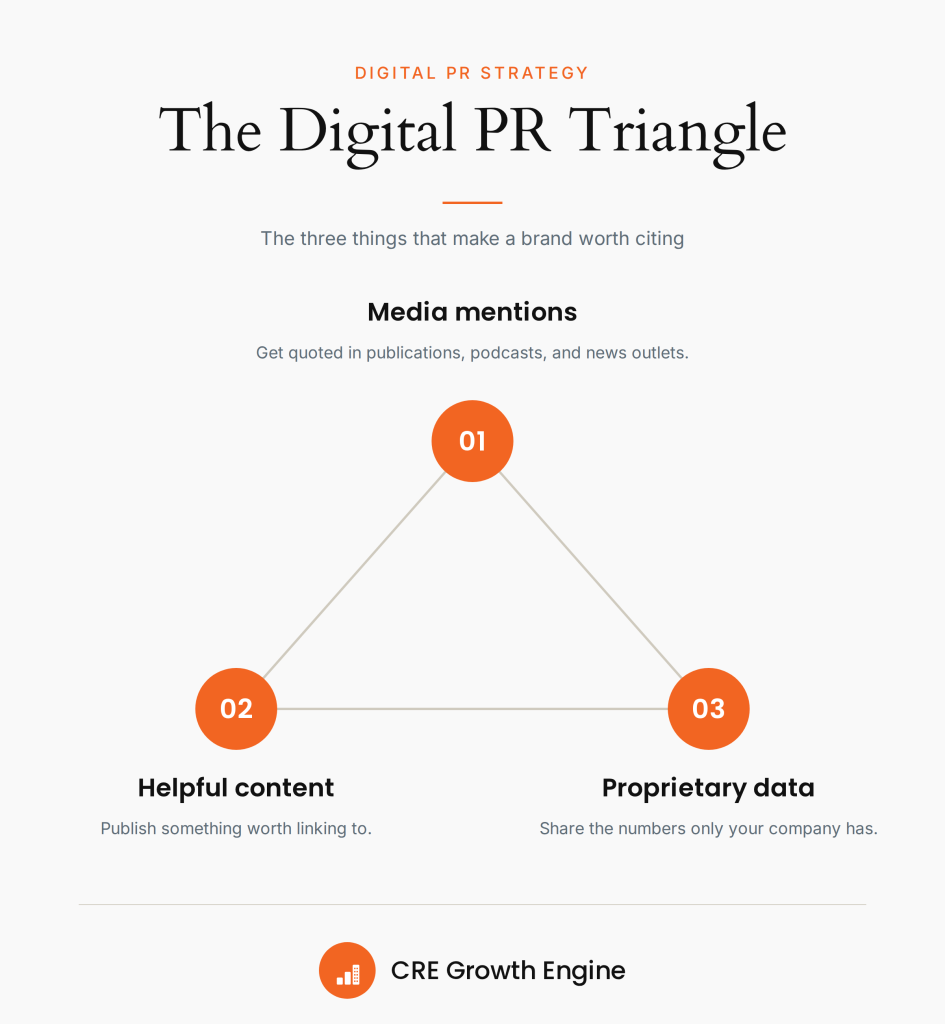
The Digital PR Triangle: the three pillars of a digital PR strategy
There are three key areas of a digital PR strategy. Media mentions. Helpful content. Proprietary data.
Media mentions
This means getting your name, your expertise, or your brand quoted in publications, podcasts, and news outlets.
My team books clients on podcasts, but not everyone takes it seriously. The mention is the point.
So respond to the journalist. Say yes to the interview, even if the topic feels unrelated to what you sell. One listener, one reader, one link sends a signal that compounds over time. Who cares if the podcast only has one listener? Your name gets out there, indexed and linked.
Helpful content that earns links
The second pillar is creating content on your website that solves a problem your audience is searching for, where your product or service happens to be part of the solution.
This is where SEO content strategy and digital PR overlap. You’re creating something worth linking to.
For example, I work with a Gold IRA company. We can create content about things like account fees and eligible metals. That’s useful, but not remarkable. What we can do to stand out is create calculators and tools so visitors can calculate their own numbers and figure out what makes sense for their situation. That’s the kind of content other sites want to reference.
For my e-commerce client that sells hidden outlets and decorative switch covers, I interviewed interior designers about upcoming design trends. Most of the article covers those trends. Colors. Textures. Materials. Then one section introduces the “invisible trend,” where homeowners hide utilitarian items like vents, outlets, and small appliances. The reader gets inspiration. They discover the product naturally as part of a helpful article.
Content like this earns links and traffic because it’s useful and helpful.
Proprietary data
This is the pillar most businesses overlook, and in my experience, it’s often the most powerful for earning media coverage and brand mentions.
Proprietary data is information only your company has. Examples can be:
- The questions customers ask on sales calls.
- Trends in what people are buying, when they’re buying it, where the demand is coming from.
- The story behind your patent.
- The regional patterns in your sales data.
Your customers may not care about this data. But reporters do. Journalists covering economic trends, consumer behavior, or industry changes need original data points to make their own stories interesting. If you can provide that, you become a source they return to.
Examples
For my e-commerce client, proprietary data could include which regions of the country buy the most hidden outlets, what the typical buyer profile looks like, or what percentage of designers prefer different concealment methods.
For my Gold IRA client, it’s when people tend to buy, what metals are most popular, and what questions come up repeatedly on calls.
This kind of data is original. AI hasn’t been trained on it. Google hasn’t indexed it. That makes it exactly what both search engines and AI platforms are looking for when they decide which brands to cite.
How to pitch journalists and respond to queries
The three pillars give you something worth saying. This is how you say it.
Most of my clients’ coverage comes from responding to journalist queries, not from cold pitching. A reporter posts what they need on a platform like Qwoted or Featured, and you answer it. It’s faster, and the reporter is already looking for you.
Step 1. Answer fast
Queries close in 24 to 48 hours and most fill sooner. If you see one in the morning and respond that afternoon, you’ve already lost to the person who answered in the first hour. Set a time each day to check.
Step 2. Answer the question they asked
Reporters reject pitches that ignore their beat or their question. Read what they’re writing. Answer that. Don’t send your company boilerplate and hope they find something usable in it.
Step 3. Keep it short and quotable
Two or three sentences per point. Write it the way you’d say it out loud, so the reporter can paste it straight into the story. Long responses get skipped because they create work.
Step 4. Give them something only you have
This is where proprietary data earns its keep. A quote is fine. A quote plus a number from your own sales data is the one that gets used.
Step 5. Include your credentials and a link
Name, title, company, and your website. Every time. That’s what turns a quote into a link.
Reactive PR and newsjacking
When something happens in your industry, reporters need a source who can talk about it that day.
Set up alerts for the topics you can speak to. When gold prices move, my Gold IRA client can explain what it means for retirement accounts. When a housing story breaks, my real estate software client has data on it. Neither of them planned that coverage. They were just ready when it came up.
This is the cheapest digital PR there is. You aren’t creating anything new. You’re being available.
Why this matters more now than ever
Search engines have always rewarded websites with high-authority backlinks. What’s changed is AI search and what it takes to get cited by AI.
AI doesn’t need another article explaining what a Gold IRA custodian does, or that there are different interior design categories. That’s not original content. AI won’t reference it.
What AI needs is new information. Original research, proprietary data, expert perspectives. Digital PR strategy is one way you can create and distribute that kind of content.
This is the difference between earned media and paid media. Paid gets you in front of people temporarily. Earned media builds a compounding layer of brand authority that makes you more visible over time, in traditional search, in AI answers, and in the conversations happening in your industry.
I can’t emphasize this enough. When more businesses realize this, there’s going to be fewer and fewer opportunities to stand out. The time to start is now.
Digital PR examples you can use today
You don’t need a massive budget. Here are ideas I’ve either implemented or recommended for my own clients.
Create a contest
My interior design e-commerce client could invite designers to submit photos of their most creative outlet concealment. Say thirty designers enter. Now we have user-generated content, social media engagement, and data we can turn into a story. Your numbers might come back looking like “15% painted over them, 12% used wallpaper.”
Those numbers are shareable, publishable, and link-worthy. Plus, we have inspiration for customers and can grow the number of designers that enter the next time we hold a contest.
Build tools and calculators
Give your audience a way to interact with your expertise. My Gold IRA client’s calculators are a perfect example. A home services company could build a cost estimator. These resources earn links because they provide ongoing, useful value.
Publish original research
Survey your customers. Analyze your sales data. Compile insights from the questions your team hears every day. Package it with metrics and graphs. Media outlets pick up original research because it gives their stories credibility.
I’ve seen this firsthand with one of my real estate software clients. We turned their raw product data into original reports, which then earned coverage in outlets like Commercial Observer, Connect CRE, CRE Daily, Best Ever CRE, and Pensions & Investments. National CRE media picked up their reports because the data behind it didn’t exist anywhere else.
Get booked on podcasts
Reach out or work with a company like ours to get booked on podcasts as a guest. Your name, your brand, and your expertise get indexed, linked, and associated with a credible platform.
| Example | Detail |
| Contest | Media mentions, user-generated content, taps into bigger audiences, creates proprietary data |
| Tools and calculators | Helpful content that helps users interact with your site, gives ongoing value, earns links |
| Data reports | Original research or proprietary data add credibility and opportunities for high-authority sites to link to you |
| Podcast guesting | Earn media mentions, build your digital footprint |
Digital PR tools I use
You don’t need a big stack. You need one tool for finding opportunities, one for tracking what you earn, and one for checking your own pages.
| What you need it for | What I use |
| Finding journalist queries | Qwoted, Featured |
| Tracking backlinks and referring domains | Ahrefs |
| Seeing which pages earn clicks | Google Search Console |
| Checking how a page looks in search | SERP Snippet Preview |
| Marking up content so search engines and AI can read it | Schema Markup Generator |
The last two are free on my site. Use them.
How to measure your digital PR strategy
Most people measure digital PR by counting coverage. Coverage is the input. These are the numbers that tell you whether it worked.
Referring domains. Not total backlinks. The number of unique websites linking to you. Check it monthly in Ahrefs. This is the clearest signal that your digital PR is building authority.
Brand mentions. Every time your name shows up, linked or not. Unlinked mentions still teach search engines and AI that your brand exists and what it’s known for.
Referral traffic. Look at your referral sources in analytics. A placement that sends people to your site is worth more than one that only sends a link.
AI citations. Ask ChatGPT, Perplexity, and Google AI the questions your buyers ask. See whether you get named. Do it monthly and write down what you find.
Branded search volume. How many people search your company name. When digital PR is working, this number climbs, and those searches convert better than anything else you’ll get.
Rankings on the pages you pointed links at. If you earned links to a page, watch that page. This is where the SEO payoff shows up.
Give it three to six months before you judge any of it. Digital PR compounds, and the first two months usually look like nothing is happening.
How to create your digital PR strategy
Pick one pillar and start there.
If media mentions feel most natural, make yourself available. Respond to journalist queries the way I described above. Say yes to every podcast invitation. Have your team pitch you as an expert source to outlets that cover your industry.
If helpful content is your strength, audit your website. Find the pages that talk about your product but don’t solve a problem. Then create one piece of useful content each month. A guide, a tool, a trend report. Something worth linking to.
If proprietary data is your advantage, start paying attention to the patterns. What are your customers asking about? What are they buying most? Where are they located? Package those insights into content. You’ll be surprised how many journalists and bloggers want that data.
Then track the numbers above so you know it’s working.
Every business can win at digital PR. You just need a strategist who knows how to put the pieces together. If you want ideas on how this could work for your business, book a call. I’ll give you ideas and opportunities to help your business grow.
Digital PR strategy: FAQs
Is digital PR worth it?
Yes, if you can commit to it for six months. Digital PR compounds. One mention does little. Twenty mentions across a year change how search engines and AI treat your brand. If you need leads next week, run ads instead.
What is a good digital PR strategy?
One that starts with something only you have. Your data, your expertise, or your customers’ questions. If your strategy starts with “we should get in Forbes,” it’s a wish, not a strategy.
What are examples of digital PR strategies?
Answering journalist queries, guesting on podcasts, publishing original research from your own data, building free tools and calculators, and running contests that create data you can pitch. All five are in this article.
How long does digital PR take to work?
You’ll see mentions within a few weeks if you’re responding to queries consistently. Ranking and traffic changes take three to six months. Branded search moves last.
Do I need a big budget for digital PR?
No. The highest-return tactic is responding to journalist queries, and that costs you time. Budget matters when you want original research or custom tools built.
Ready to get found? Get a free audit.