If you want to know how to get cited by AI, start where I did. In a citation report.
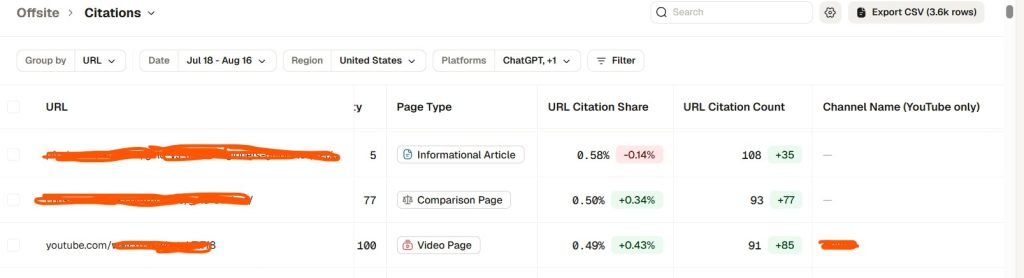
I was in AirOps looking at my gold and precious metals client’s citations, checking which sources the models pull from in their category. The third most cited source was a competitor’s YouTube video, published a month earlier, with 91 citations. It picked up 85 of those in a single month, and it was the only source in the top three gaining citation share.
Key takeaways
- Video is a citation source: The third most cited source in key terms for my client was a competitor’s YouTube video, one month old and still climbing. Not an article. A video.
- Getting found on YouTube and getting found because of YouTube are two different jobs: Thumbnails, watch time, and subscribers decide what happens inside YouTube. None of that pulls a video into a Google result or an AI answer.
- The winning video wasn’t special: It didn’t have proprietary data or an unusual take. My client could say all of it better but the competitor said it first.
What gets cited by AI?
Content that ranks in Google search says something the model can’t generate on its own, and puts the answer where it’s easy to lift.
Google published its own guidance on this in May 2026. Its generative AI features are rooted in the same core ranking and quality systems as regular search, and they pull from the same search index. Google also named the things you can skip:
- No llms.txt file.
- No chunking your content for machines.
- No AI-specific rewrite of pages you already have.
- So there’s no separate AI channel to optimize for.
Four things you need to do:
- Rank first. If a page or a video doesn’t rank in Google for the question, it isn’t in the pool the models draw from, and no amount of formatting changes that.
- Say something the model can’t say without you. A number you measured, a process you run, a result you saw. Google’s helpful content guidance leads with original information, reporting, research, or analysis. Content that repeats what every other page says gives the model no reason to name a source.
- Answer the question in one liftable passage. Open the page, and each section, with a sentence that stands on its own. A model that’s quoting you needs a complete answer it can pull without stitching three paragraphs together.
- Show up where the models already look. The citations keep landing on the same domains. Reddit, YouTube, LinkedIn, Wikipedia. Your own site is one source. A video, a thread, or a profile on a domain the models already cite is another.
YouTube SEO vs YouTube in Google results
YouTube channel growth is a whole discipline. Thumbnails, watch time, subscriber counts, posting cadence. That’s a different discipline, and it belongs to somebody who does it every day.
I’m focused on the video outside YouTube:
- Does it rank in Google?
- Do the models cite it when someone asks a question in your category?
- Does a page on your site carry the same answer so the text version gets indexed too?
What I found in the citation report
I watched the video. There’s nothing in it my client couldn’t cover. The difference was that the competitor made the video and my client hadn’t.
Two months ago, I already gave this client a list of videos to make specifically for Google search, and they’ve been working through it. But I built that list for Google SEO. Rank the video and show up in the results for that search term.
I’d built strategy from Google search data, and I treated YouTube as a separate platform with its own rules. That’s no longer accurate, and I didn’t notice until this report. The video ranks in Google, and once it ranks in Google, the models cite it.
Why do AI models cite YouTube?
This isn’t a quirk of one client’s category.
Semrush studied 230,000 prompts and over 100 million AI citations across ChatGPT, Google AI Mode, and Perplexity between July and October 2025. On Google AI Mode, YouTube came in second among all cited domains, behind only LinkedIn.
Peec AI ran a separate study across 30 million sources on ChatGPT, Google AI Mode, Gemini, Perplexity, and AI Overviews. They put YouTube second overall behind Reddit, and first on both Google AI Mode and AI Overviews.
The two studies disagree on the exact order. Both put YouTube in the top three. Peec adds that the models use both the video description and the auto-generated transcript.
Where does a YouTube video earn visibility?
Here are three ways one video can give your business visbility:
| Where the video shows up | What decides it | Who’s optimizing for it |
| YouTube search and suggested | Watch time, thumbnail click-through, session length | Most channels, if anyone |
| Google search results | Page relevance, transcript, structured data, how the video ranks on its own | Rarely |
| AI answers and citations | Whether the video is the clearest source on one specific question | Almost nobody |
How to get cited by AI when a competitor already is
If you haven’t focused on optimizing your channel, here are steps you can take:
Step 1. Pull the citation data
Find out which sources the models already cite in your category. Not which pages rank. Which sources get quoted when someone asks a question about what you sell. I use AirOps for this. Note, this is an affiliate link.
Step 2. Find the video behind the citations
Sort by citations and look at the format column. A video in the list is a gap in your own content.
Step 3. Take the video apart
I pulled the competitor’s full transcript and read it the way I’d read a top-ranking article.
- What question does it answer?
- What order does it answer things in?
- What do the chapters say?
- What’s in the first two lines of the description?
The video opened with polling statistics, then listed six evaluation criteria and covered them in eleven minutes. That’s the structure behind 91 citations.
Step 4. Create the key points for the video
I shared with my client the key points the video needs to cover and in what order, based on the competitor’s video.
I also pointed out where my client is different and should say so. The competitor doesn’t publish their own sales data. My client does. Plus, my client has better pricing options than the competitor that they should also mention.
Step 5. Give the editor the details
I gave the editor the exact title, tags, description, and chapter labels as finished text to paste. This also included ideas on captions, end screen, and other video elements.
Finally, I wrote a companion blog article to link to the video and vice versa.
How I’m tracking whether it worked
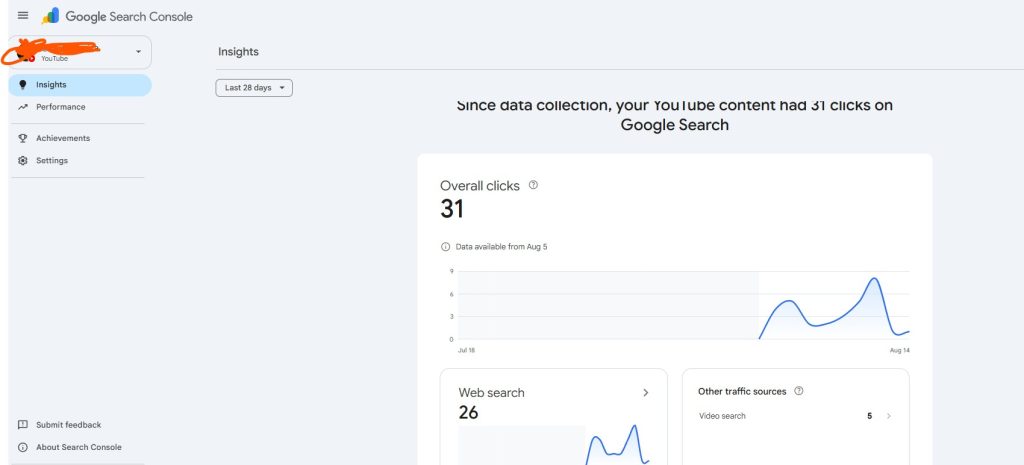
Two weeks ago I added the client’s YouTube channel to Google Search Console as a platform property. It’s the same verification flow as a website, and it shows which Google queries are surfacing the channel’s videos.
YouTube Studio reports on what happens inside YouTube. It won’t tell you a video is showing up in Google for a question your sales team hears every week.
In the first ten days we’ve been tracking, five of the channel’s Google clicks came from video search. Twenty-six came from regular web search results.
None of that is from the video I briefed, because it hasn’t been recorded yet. A channel’s Google visibility can come from videos ranking as results, which is the same pool the models draw from.
Note on results and timing
I don’t yet have a case study with AI citation numbers, because this is the first client where I’ve tracked video as a citation source.
What I have is the chain:
- The gap came from a citation report.
- I provided key points and the editor spec
- The companion article is live.
- The video comes next, and the channel is in Search Console with ten days of data.
I’ll publish the numbers when I have them.
Final thoughts on finding an AI citation gap
Start with the citation data. You need to know which sources the models already cite in your category before you decide what to record. If a video shows up in that report and it isn’t yours, that’s your next piece of content.
Want to see what’s in your citation report? Book a free strategy call.
How to get cited by AI: FAQs
Do I need a big channel for this to work?
No. The video in my client’s citation report came from a channel with a modest following and reached 91 citations in a month. Citations follow the answer, not the subscriber count.
How many videos does this take?
I don’t know yet. The competitor got 91 citations with one video. I’m starting my client with one, on the question the report pointed out, and I’ll know more once it’s been live a month.
What if my competitor already has the video?
You can still take the topic, but you can’t say the same thing they said. Google’s guidance is that content has to add substantial value over what’s already out there, so a copy gives the model no reason to name you instead of them.
In my client’s case, the difference is their own published sales data. The competitor doesn’t have that, so we’ll add that in the video.
Does the video need to live on my site too?
No, and embedding it won’t make the page rank better. What embedding can change is which URL shows up as the video result.
John Mueller said in 2021 that Google picks between the two based on which page has more signals or more information on it. So if your page carries the transcript and the full written answer, your page can be the one that surfaces instead of YouTube.
Can I just use YouTube’s automatic captions?
No. YouTube’s own help page says automatic captions can misrepresent what was said because of mispronunciations, accents, or background noise, and that you should review and edit them. The transcript is the text a model reads, so a garbled company name or a wrong figure is what ends up quoted.