The real question isn’t SEO vs AEO. It’s how the two work together, because one is built on top of the other.
AEO stands for answer engine optimization. It’s the work of making sure AI tools like ChatGPT, Perplexity, and Google’s AI Overviews cite you when someone asks a question your business can answer. Most of what earns you that citation is the SEO you’re already doing.
That’s the part the debate keeps missing. AEO isn’t a new discipline. It’s your SEO foundation plus one new input, and a lot of what’s being sold as AEO right now is repackaged SEO with a new invoice attached.
About a year ago I told my gold company client they were getting cited by AI. They said they didn’t even know what that meant. Was it good? It sounded like it might be good. Nobody asks that anymore. You can’t escape AI as part of search now. Even if you search Google the traditional way, you’ll see AI Overviews from Google itself.
Key takeaways
- AEO builds on SEO: The structure, meta, titles, and helpful content that matter for SEO are the same foundation AI search pulls from. You can’t get picked up without those pieces.
- Unique content stands out: AI has been trained on everything that already exists. To get mentioned, it wants information only you have, so pull from your own data.
- Trust signals still matter: Reviews and getting featured on other sites still count. It all builds on each other.
SEO vs AEO vs GEO, and what each one means
You’ll see three acronyms thrown around, and they get used interchangeably even though they aren’t the same thing.
SEO is search engine optimization. Getting found in Google and Bing results.
AEO is answer engine optimization. Getting pulled into AI Overviews, featured snippets, and voice answers.
GEO is generative engine optimization. Getting mentioned inside ChatGPT, Perplexity, Gemini, and Claude.
Here’s how the three compare.
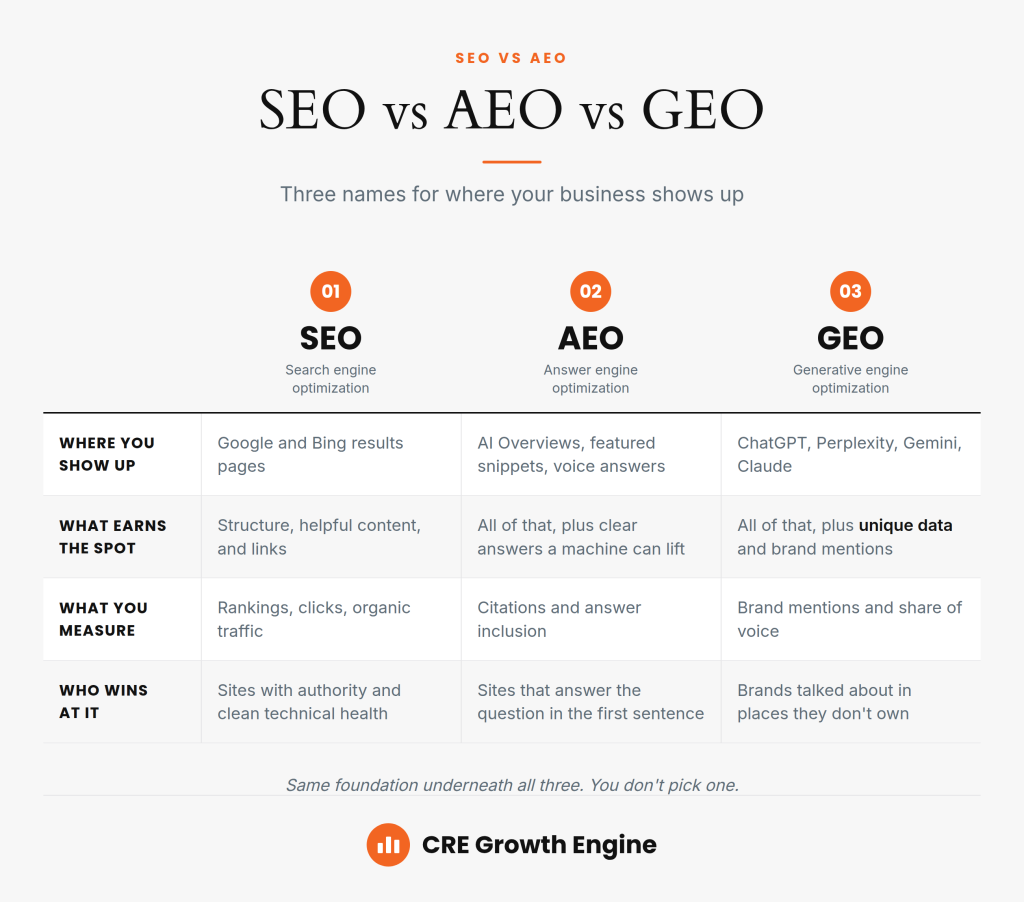
| SEO | AEO | GEO | |
| Where you show up | Google and Bing results pages | AI Overviews, featured snippets, voice answers | ChatGPT, Perplexity, Gemini, Claude |
| What earns the spot | Structure, helpful content, and links | All of that, plus clear answers a machine can lift | All of that, plus unique data and brand mentions |
| What you measure | Rankings, clicks, organic traffic | Citations and answer inclusion | Brand mentions and share of voice |
| Who wins at it | Sites with authority and clean technical health | Sites that answer the question in the first sentence | Brands talked about in places they don’t own |
Look at the second row. Every column starts with the same thing. That’s the whole point. You don’t pick one of these. You build the foundation once, and it feeds all three.
AI search is growing, but Google still sends the traffic
AI assistants generate roughly 45 billion sessions a month worldwide. For prompts that look like real searches, that’s about 28% the size of search. The methodology behind that number gets debated, so treat it as a signal of scale rather than a precise figure.
It also changes what people do once they search. Ahrefs found that AI Overviews are tied to a 34.5% lower click-through rate for the number one result on informational queries. The answer is at the top of the page, and a lot of people (like me!) read it without clicking through.
That sounds alarming until you look at where traffic still comes from. When Ahrefs studied 35,000 sites in March 2025, Google sent about 345 times more traffic than ChatGPT, Gemini, and Perplexity combined. AI’s share has roughly doubled since then, so the gap is narrower now. It’s still enormous.
Traditional search also rewards patience. 72.9% of pages in Google’s top 10 are more than three years old, so the pages you publish now can keep working for you for years.
So SEO isn’t going anywhere. It’s still where the clicks come from, and it’s the same foundation AI search pulls from.
The citation stack
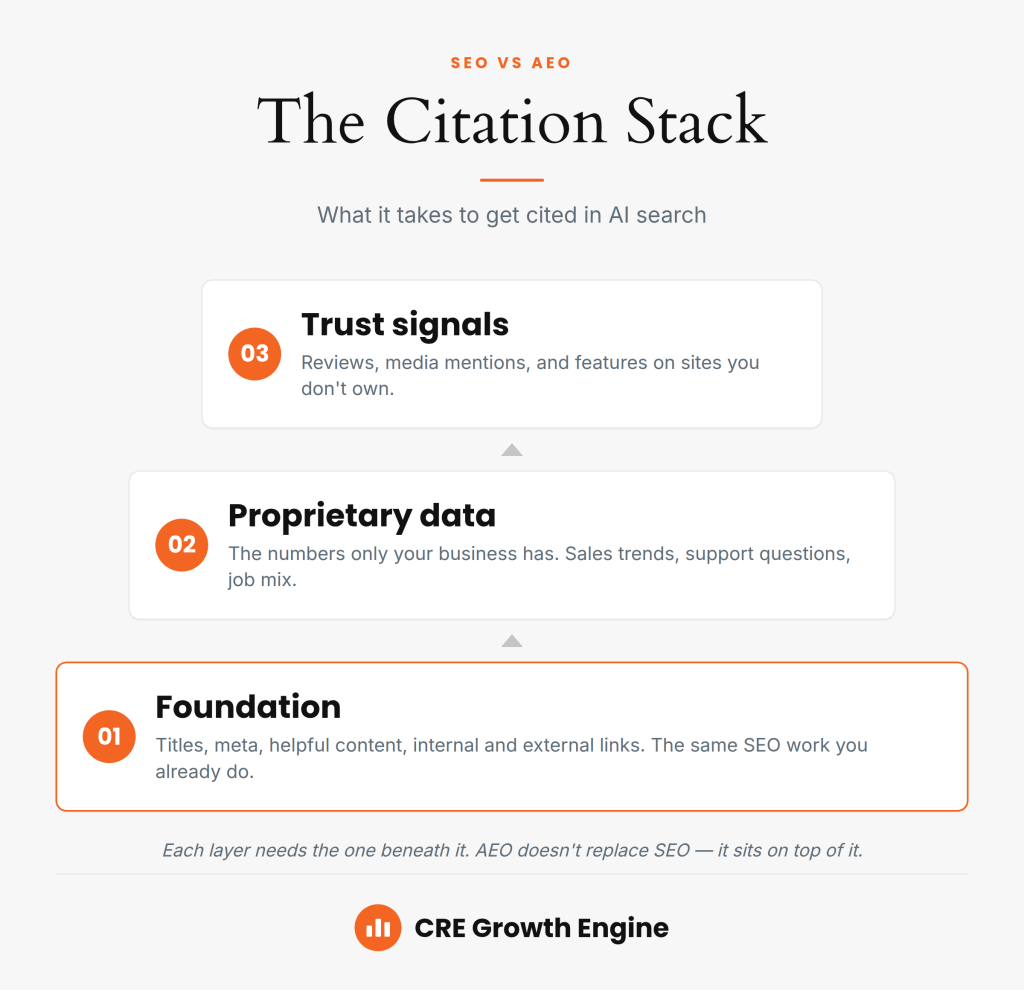
Everything that gets you cited in AI search sits in three layers. Each one needs the layer underneath it.
Step 1. Get the foundation right
This is the part that doesn’t change. Titles and meta descriptions. Helpful content. Linking out to good sources and across your own site.
If your pages aren’t built well, none of the rest matters. AI search can’t cite a page it can’t understand.
One thing worth adding here for AI search specifically. Answer the question in the first sentence of the section, then explain. AI tools lift short, clean passages. If your answer arrives in paragraph four, it won’t get pulled. Structure your headings as the questions people ask, and use schema markup so the page tells search engines what it is.
Step 2. Share data only you have
This is the layer I find most interesting, because it’s the one your competitors can’t copy.
AI has been trained on everything that already exists. Generic definitions and product pages don’t give it anything new. Your own data does.
If you’re a software company, look at what’s already sitting in your systems. Help desk tickets. The questions people ask most. How people use the product. Industry patterns you can see from usage.
Here’s what that looks like across my clients.
- Gold company. We take sales data and create a report on sales trends.
- Real estate software company. I take platform data and create biannual reports on who’s raising capital in which area, and which areas of commercial real estate are growing.
- Local contractor. We look at the kinds of calls you get, the types of jobs by percentage, and how long projects take.
You can also share data about the business itself. Not what you do, but what it’s been like to build it. The path you took. Patents you hold. Partnerships you’ve created. Nobody else has that information.
Step 3. Build trust signals off your site
Both AI and Google pull signals from places you don’t control. This is what tells them you’re worth citing.
- Reviews. Ask for them consistently. They show up in local results, and AI answers pull from them.
- Mentions on other websites. Getting named in an article counts even without a link.
- Guest posts. They put your name and your thinking on a site with its own audience and authority.
- News article quotes. Respond when a journalist asks. Say yes to the interview even when the topic feels unrelated to what you sell. The mention is the point.
- User-generated content. Reddit threads, forums, and social posts where real people talk about you. AI tools lean on these more than most business owners expect.
How to measure AEO
You already know what SEO looks like when it’s working. Rankings, clicks, organic traffic. AEO needs its own set, because a citation without a click still counts.
| What to track | What it tells you |
| Citations in AI answers | Whether AI tools name you when buyers ask about your category |
| Brand mentions across the web | How often your name shows up on sites you don’t own |
| Share of voice on your key questions | Whether you or a competitor gets named on the prompts that matter |
| Referral traffic from AI tools | The clicks you do get from ChatGPT, Perplexity, and Gemini |
Pick the ten questions a buyer would ask before hiring someone like you. Run them through ChatGPT and Perplexity once a month and write down who gets named. That’s your baseline, and it takes about twenty minutes.
How to get found in AI search
Start at the bottom of the stack and work up.
- Fix the foundation. Titles, meta, structure, internal links.
- Rewrite your key pages so the answer comes first.
- Pick one piece of data you already have and turn it into something you can publish.
- Keep asking for reviews and say yes when someone wants to feature you.
- Track your ten buyer questions monthly.
Don’t do all five at once. Step 3 is where most businesses find the biggest gap, so if you only pick one, pick that one.
SEO vs AEO: FAQs
Will AEO replace SEO?
No. AEO runs on the same foundation SEO does, so replacing one with the other isn’t possible. Google still sends far more traffic than every AI tool combined, and the pages that get cited in AI answers are usually the ones already built well for search.
Is AEO better than SEO?
Neither is better. They answer different questions. SEO gets you clicks from search results. AEO gets you named inside an answer, which builds trust even when nobody clicks. Most businesses need both, and the work overlaps more than it differs.
What is SEO and AEO?
SEO is search engine optimization, the work of getting your pages found in Google and Bing. AEO is answer engine optimization, the work of getting your business cited inside AI generated answers. AEO builds on SEO rather than replacing it.
What’s the difference between AEO and GEO?
AEO is about getting picked as the direct answer in AI Overviews, snippets, and voice results. GEO is about getting mentioned inside generative tools like ChatGPT and Perplexity. The line between them is blurry and getting blurrier, and the work that earns both is nearly identical.
Ready to get found in AI search? Click here for a free audit.