If you’re a business owner looking to grow with new lead sources, this article shows you where to start.
I work with businesses that were successful for years without any of this. Referrals. Radio. Word of mouth. Now those lead sources are slowing down, or they cost too much. And the businesses that don’t build an online presence will lose out to the ones that already have.
What is an SEO content strategy?
An SEO content strategy is the plan that connects your website, your content, and your keywords so search engines and AI platforms know what you do, where you do it, and why someone should choose you. It covers keyword research, page structure, content planning, internal linking, and measurement. The goal is that every page sends a clear signal about your business.
Key takeaways
- Your leads aren’t the problem, your visibility is. If you grew by referrals or advertising channels that are slowing down, it’s because your customers moved online.
- Start with the fundamentals. Google Business Profile, keyword targeting, city pages, and service pages that speak to what you do.
- Your competitors are already doing this. Others are investing in SEO and AI visibility right now. The longer you wait, the bigger the gap.
Start with who’s searching and what they want
Before any of the technical work, you need to know who you’re writing for and what they’re trying to do when they search.
Most business owners skip this and go straight to keywords. That’s how you end up with a page that ranks and still doesn’t get you a call.
Every search falls into one of four intents. Match the intent and the page works. Miss it and nothing else you do to the page matters.
| Intent | What the searcher wants | Example search | What the page should be |
| Informational | To learn something | “what is a hidden outlet” | A blog post or guide |
| Commercial | To compare options before buying | “best flush mount outlets” | A comparison or roundup |
| Transactional | To buy or hire right now | “buy hidden outlet covers” | A product or service page |
| Navigational | To find a specific company | “flushmount outlets phoenix” | Your homepage or location page |
Here’s how to check. Type your keyword into Google and look at what’s already ranking. If the first page is all product pages, a blog post won’t rank there. If it’s all guides, your service page won’t either. Google has already decided what type of page answers that search. Match it.
Then think about who’s on the other end of that search. A commercial buyer searching for your service and a homeowner searching for the same service want different things from the page. If your site only talks to one of them, you’re invisible to the other.
If your leads are drying up, your visibility is the problem
The most common business I work with is a company that was successful for years with one lead source. Referrals. Radio. Word of mouth through industry relationships. Whatever it was, it worked.
Until it didn’t.
My gold company client told me that for years, radio ads were fantastic. But people aren’t listening to the radio anymore. They’re online. And even if we were only focused on Google search, that’s changing too, because more and more people are using ChatGPT and Perplexity to find businesses.
The whole goal of an SEO strategy is to match the searcher with what you do.
What happens when a business has no SEO?
I work with a home audio and video company that got referrals for years through home builders. But home builders are struggling right now. People aren’t building as many homes with current interest rates, and those builder relationships are aging. The new generation of builders is about margin and lower cost, not relationships.
My client realized things are changing. If they don’t put a strategy in place, the leads stop coming.
This is a business that’s been operating for 20 years and has no SEO foundation. No keyword targeting. No local pages. No service detail. Just a website that existed but didn’t work for them.
That’s more common than you’d think.
A real example. E-commerce site, zero SEO, seven weeks
I work with an e-commerce client that sells home remodeling items. When we started in June, the site was ranking for 34 organic keywords and getting about 173 visits a month from search. Zero AI citations.
Not showing up in ChatGPT, Perplexity, Google AI Overviews, or any AI platform. The site had been losing traffic for over a year. The trend line was going straight down.
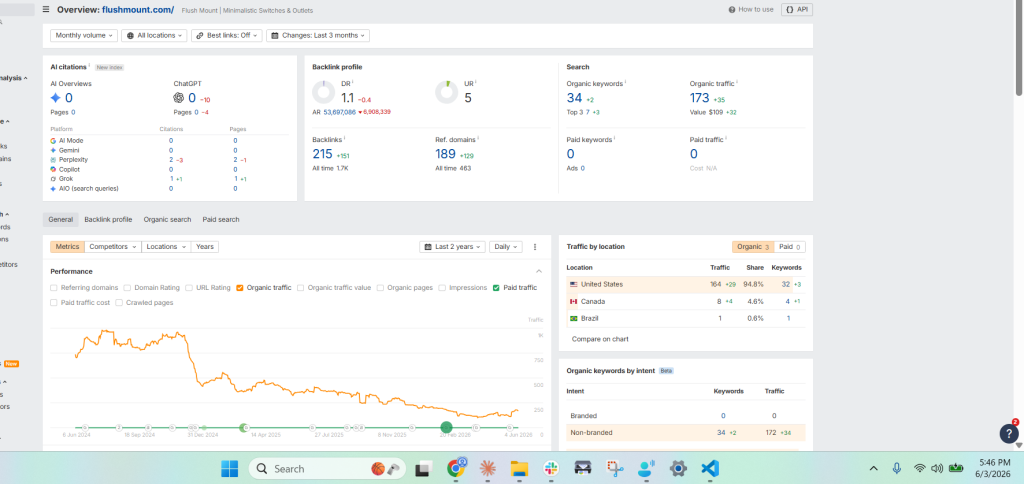
This is a company with a good product and consumer demand. But their website wasn’t sending any of the right signals to search engines or AI.
Here’s what we did in seven weeks.
Step 1. Audit the site
Before we touched anything, I audited the site. I looked at the technical setup, the content, and how the site compared to its top competitors.
For the competitor piece, I ran their three closest competitors through Ahrefs and pulled the keywords those sites rank for that my client doesn’t. That list becomes the content plan. You’re not guessing what to write about. You’re looking at what’s already working for someone else selling the same thing.
The title tags and meta descriptions weren’t targeting anything specific. They weren’t using the words customers type into Google when they search for these products. The site was fairly new, so there wasn’t a big mess to clean up.
It just wasn’t sending any signals to Google. No keyword targeting. No structure that told search engines what the site was about or why it should show up for any particular search.
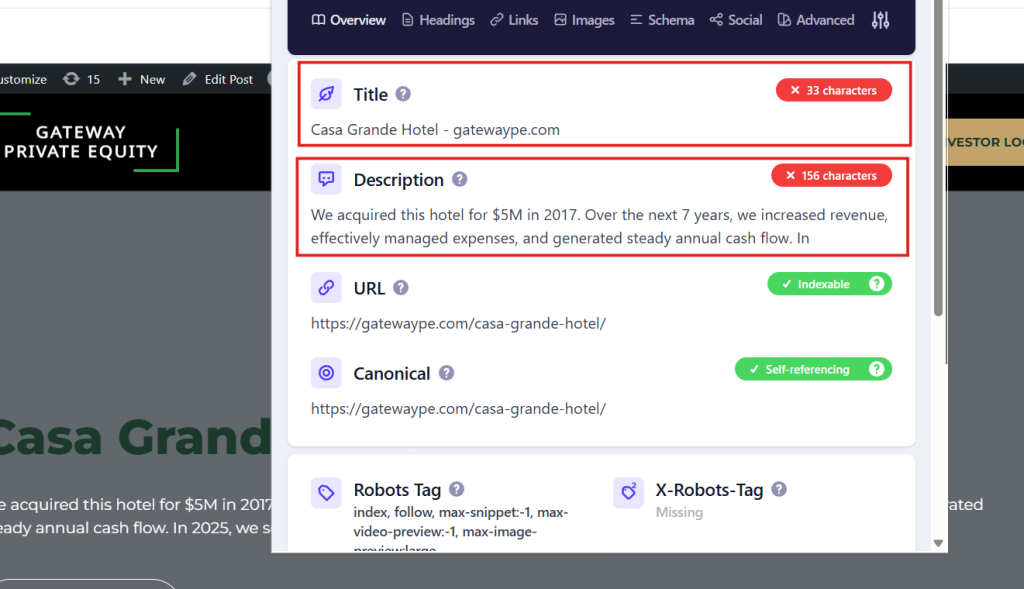
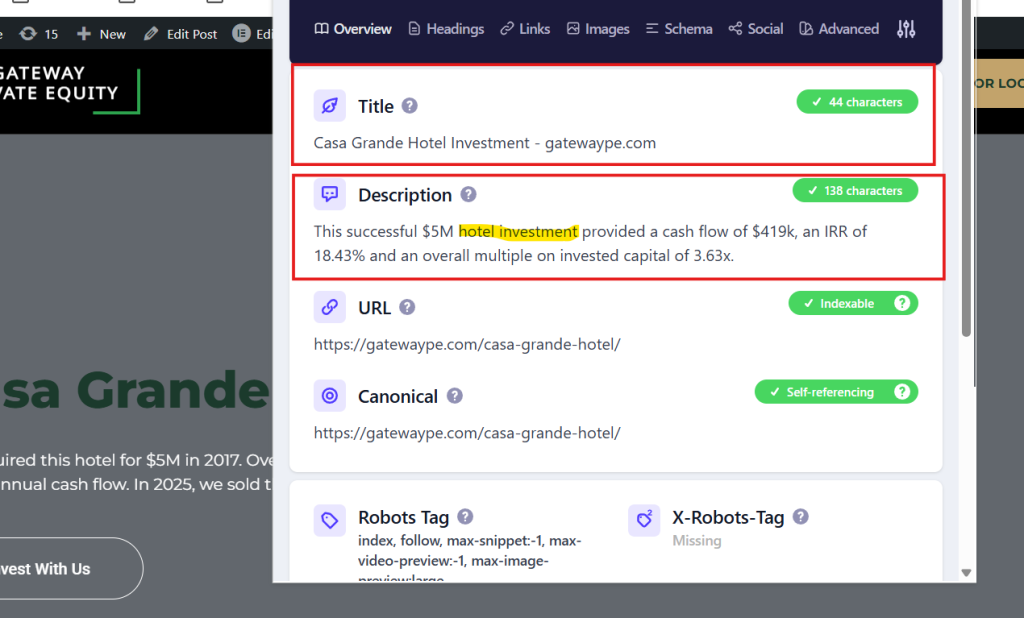
That description shows up in Google search results as the short snippet below your page title. It’s what your potential customer reads before they decide to click.
Step 2. Keyword research
For this same e-commerce client, we did keyword research for their seven product category pages. We want every page to send signals to Google and AI search engines.
We’re looking for keywords with volume the business can use and a difficulty score low enough to win. That dictates what we say on the page.
Take the hotel investment example. That keyword gets 250 searches a month with a keyword difficulty of 10. Low volume, but almost nothing standing in the way of ranking for it.
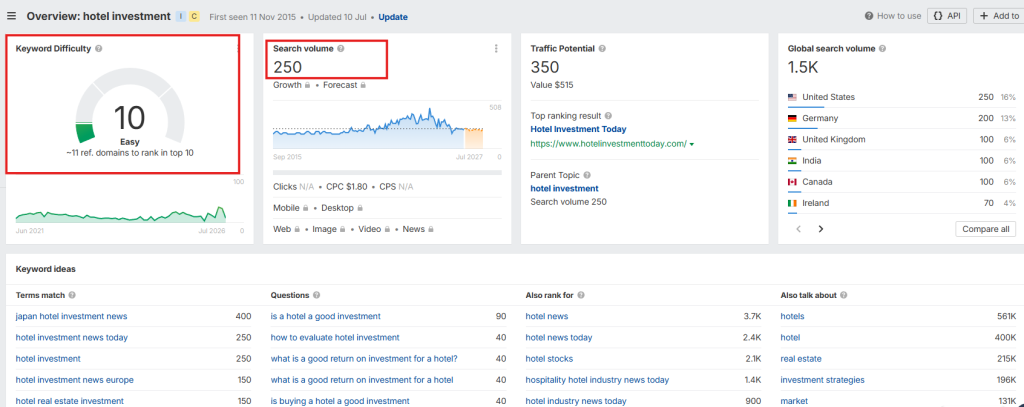
There are many ways to say the same thing, and the point of keyword research is to think about what the person searching wants, match it, and then put those words on your website. For that same intention around hotel investments, here are other keywords we could have used.
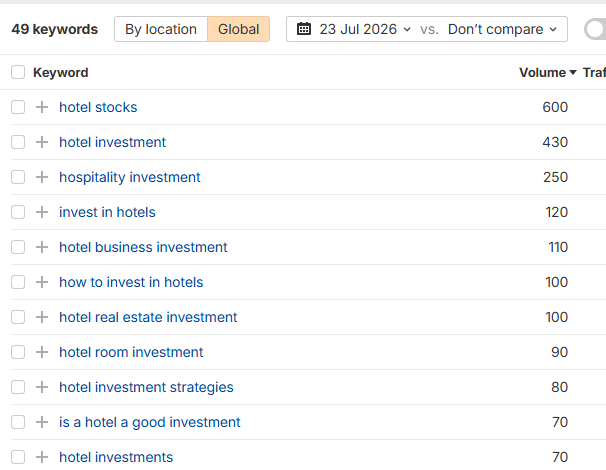
Keyword research takes time. There are a lot of different ways to come at it. You might be looking at any of these.
- The types of questions people are asking
- Comparisons they’re making
- Problems they’re trying to solve
All of that goes into keyword research.
Step 3. Create pillar pages
The site had products, but no category pages. No structure that told search engines what types of products they sell and why each category matters.
This is where pillar and spoke comes in, so let me define it.
A pillar page is the broad page that covers a whole topic. For an e-commerce site, that’s the product category page. For a service business, it’s the service page. It targets the main keyword and it’s the page you want ranking.
A spoke is a narrower page that covers one piece of that topic in depth. Usually a blog post. Each spoke targets a specific long tail keyword and links back to the pillar.
So a pillar page on hotel investment gets spokes on how to finance a hotel purchase, what cap rates look like in that asset class, and what to look for in a hotel property. Each spoke ranks for its own search. Each one passes authority back to the pillar. Over time, Google reads the whole cluster as evidence that you know the topic.
We created the category pages and wrote briefs and on page SEO for each one. Title tags. Meta descriptions. Content that explains what the category is, who it’s for, and why it matters. Then we published them and submitted each page to Google Search Console so Google would crawl and index them faster.
That’s the difference between a website that has products on it and a website that ranks for the searches people use to find those products. For service businesses, the same logic applies to service pages. If you do commercial and residential work but your site only mentions residential, you’re invisible to every commercial buyer searching online.
Step 4. Internal linking
We planned the internal linking between categories, products, and the blog. Internal links tell search engines which pages on your site are most important and how they relate to each other.
If your category page links to your product pages, and your blog posts link back to your category pages, Google understands the structure of your site. Without internal links, every page is an island. Google has to guess how they connect, and it usually guesses wrong.
Step 5. Speed and performance
There are technical aspects of SEO you need in place too. This e-commerce site has a lot of product images, so we added a caching plugin and an image optimization plugin. They’re simple to install and they make the site load faster. If your site is slow, you’re losing rankings and losing visitors who won’t wait for it to load.
Step 6. New content
We did keyword research and built a content plan for the first 12 blog posts. Each post targets a specific keyword, answers a specific question, and links back to the relevant category or product page.
This is where an SEO content strategy goes beyond having a website. Every piece of content supports every other piece. Blog posts drive traffic to category pages. Category pages drive traffic to product pages. Product pages convert visitors into customers.
The results after seven weeks
Seven weeks isn’t very long, and SEO takes time. You should measure results in a 3 to 6 month window. But let’s look at what happened after the basics went in.
The site went from 34 organic keywords to 47. Organic traffic went from 173 visits to 223, and the trend flipped from declining to climbing. The site started showing up in AI Overviews and ChatGPT for the first time.
| Metric | June (before) | Seven weeks later |
| Organic keywords | 34 | 47 |
| Monthly organic visits | 173 | 223 |
| Traffic trend | Declining for over a year | Climbing |
| AI citations | 0 | Showing up in AI Overviews and ChatGPT |
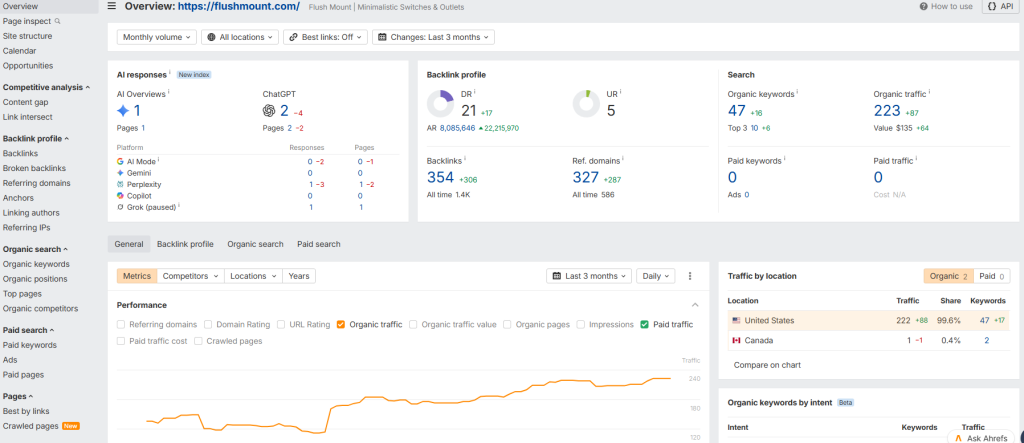
We’re currently focused on creating new content, which isn’t reflected in these numbers.
How to measure your SEO content strategy
You can’t tell if any of this is working without checking. Two free tools do most of the job.
Google Search Console tells you how you show up in search. Open the Performance report and turn on all four metrics. Clicks, impressions, average position, and click-through rate. Then look at three things.
- Pages. Which pages are getting impressions and which ones Google is ignoring. A page with impressions and no clicks is ranking but not compelling enough to click. That’s usually a title tag and meta description problem, and it’s a fast fix.
- Queries. What people typed to find you. This is where you find keywords you didn’t target and should have. If a page gets impressions for a search you never wrote about, add a section about it.
- Average position. Anything sitting between position 5 and 20 is your best opportunity. Those pages are close. A stronger page and a few internal links can move them onto page one.
Google Analytics tells you what happens after the click. How long people stay, what they do next, and whether they fill out a form or call.
Check monthly, not daily. SEO moves slowly enough that daily numbers just create noise. And track your keyword count and organic traffic month over month, because the trend line matters more than any single number.
Refresh the content you already have
Most business owners think SEO means writing more. Often your biggest wins come from fixing the pages that already exist.
Content decays. A page that ranked two years ago slips as competitors publish something better, or the information goes stale, or the search itself changes. Google notices.
Twice a year, pull up Search Console and sort your pages by clicks. Look for the ones that used to perform and don’t anymore. Then update them. Add the sections competitors cover that you don’t. Refresh the numbers and dates. Add internal links from newer posts. Rewrite the title tag if the click-through rate is low.
Updating a page that already has some authority is faster and cheaper than starting a new one from zero.
How to show up in AI search
SEO is sending signals to the places where people are searching. Every page on your website, every keyword you target, every category page you create is a signal.
And it isn’t just Google anymore. More people are using ChatGPT, Perplexity, and other AI tools to find businesses and get recommendations. Google has AI Overviews that pull quick answers from the sites it trusts most.
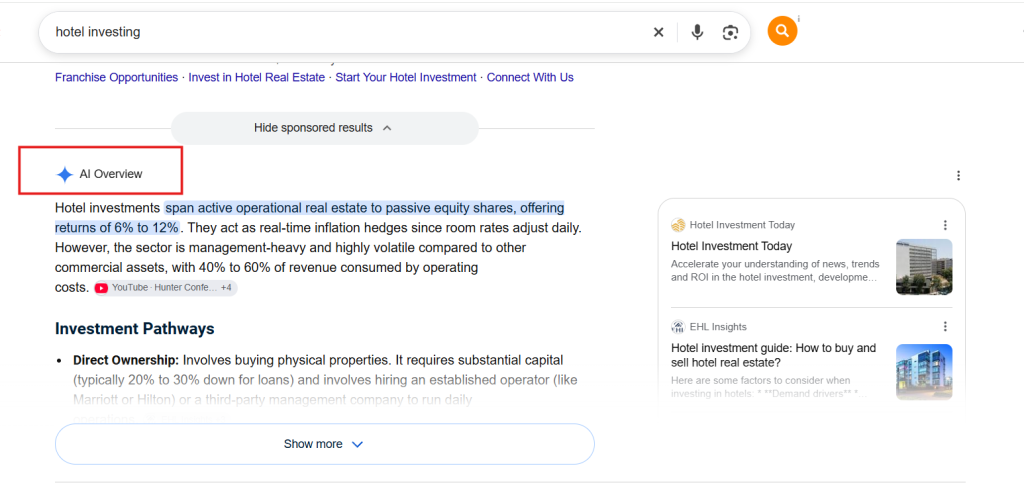
The fundamentals get you most of the way there. A few things move the needle specifically for AI.
- Answer the question in the first two sentences. AI pulls short, direct answers. If your definition is buried in paragraph four, it won’t get cited.
- Use questions as headings. Write the heading the way someone would ask it, then answer it directly underneath.
- Add schema markup. Schema tells search engines and AI what your page is, who wrote it, and what it covers. You can generate it with a free schema markup generator and paste it into your page.
- Get mentioned somewhere else. AI platforms weight what other sites say about you. That’s where digital PR comes in.
Amplifying your SEO content strategy
The e-commerce client is seven weeks in. My gold company client shows what happens further down the road when you combine an SEO content strategy with digital PR.
That client has earned coverage and links from CBS News, AOL, TheStreet, Seeking Alpha, Money Saving Expert, and Wealth Management. None of it was paid. Those publications linked because the content and the brand earned their attention.
That’s what compounding looks like. The fundamentals get you found in search. The content earns attention. The digital PR earns links from sources search engines and AI already trust. Each piece feeds the others.
Your competitors are already doing this
Your competition is investing in SEO. They’re showing up in search results. They’re getting the leads that used to come to you through referrals and relationships.
They’re not better at what they do. They’re just easier to find.
The businesses that start now build a lead that compounds. The ones that wait have more ground to cover later.
Where to start with your SEO content strategy
You don’t need to do all of this at once. Work down the list in order.
| Step | What it does |
| 1. Audit what you have | Shows you which pages exist, what they’re targeting, and where the gaps are |
| 2. Check search intent | Tells you what kind of page each keyword needs before you write it |
| 3. Do keyword research | Finds the searches with volume you can use and difficulty you can beat |
| 4. Build the missing pages | Service pages, category pages, and city pages for anything you offer or serve |
| 5. Connect them | Internal links from spokes to pillars so Google reads the structure |
| 6. Measure and refresh | Search Console monthly, content refresh twice a year |
Start with the audit. It’s free to look, and it usually turns up two or three pages you can fix this week that will do more than a month of new blog posts.
Then give it time. SEO compounds. The businesses that publish consistently and keep their profiles current are the ones that pull ahead.
SEO content strategy: FAQs
What is an SEO content strategy?
An SEO content strategy is a plan for creating and organizing website content so search engines and AI platforms can find your business. It covers keyword research, search intent, page structure, content planning, internal linking, and measurement. The goal is for every page to send the right signals about what you do, where you do it, and who you do it for.
What’s the difference between an SEO strategy and a content strategy?
An SEO strategy is about visibility. Keyword targeting, technical setup, site structure, and links. A content strategy is about what you publish and who it’s for. An SEO content strategy is both. You’re deciding what to write, who it’s for, and how it gets found, at the same time instead of one after the other.
What are the 5 pillars of content strategy?
Most frameworks land on the same five. Audience, meaning who you’re writing for. Goals, meaning what the content is supposed to do for the business. Topics, meaning what you cover and how it connects. Production, meaning how it gets written and published. Measurement, meaning how you know it worked.
How long does SEO take to work?
Most businesses see movement in 3 to 6 months. My e-commerce client went from declining traffic to a climbing trend in seven weeks. But SEO compounds. The real results come from months of consistent work on a strong foundation.
Do I need to blog to do SEO?
Blogging helps, but it isn’t the only thing. Your service pages, category pages, product pages, Google Business Profile, and internal linking matter just as much. Your biggest early wins usually come from fixing the pages you already have, not from publishing new blog posts.
What’s the difference between SEO and AEO?
SEO focuses on ranking in traditional search engines like Google. AEO focuses on showing up in AI platforms like ChatGPT, Perplexity, and Google AI Overviews. Both matter now, and an SEO content strategy is the foundation for both.
How much does SEO cost for a small business?
It depends on the scope. Some businesses need a full strategy and ongoing content production. Others just need the fundamentals in place. The investment ranges, but the businesses that see the best return commit to consistent effort over time rather than a one time project.
Ready to get found? Click here for a free audit